Keep Your Comfort Zone Cozy with These Maintenance Tips
The Foundation of Home Comfort: Why HVAC Maintenance Matters
Understanding how to maintain your heating and cooling system is essential for any homeowner. Proactive care ensures your system runs smoothly and efficiently, preventing unexpected issues and keeping your home comfortable.
How to Maintain Your Heating and Cooling System:
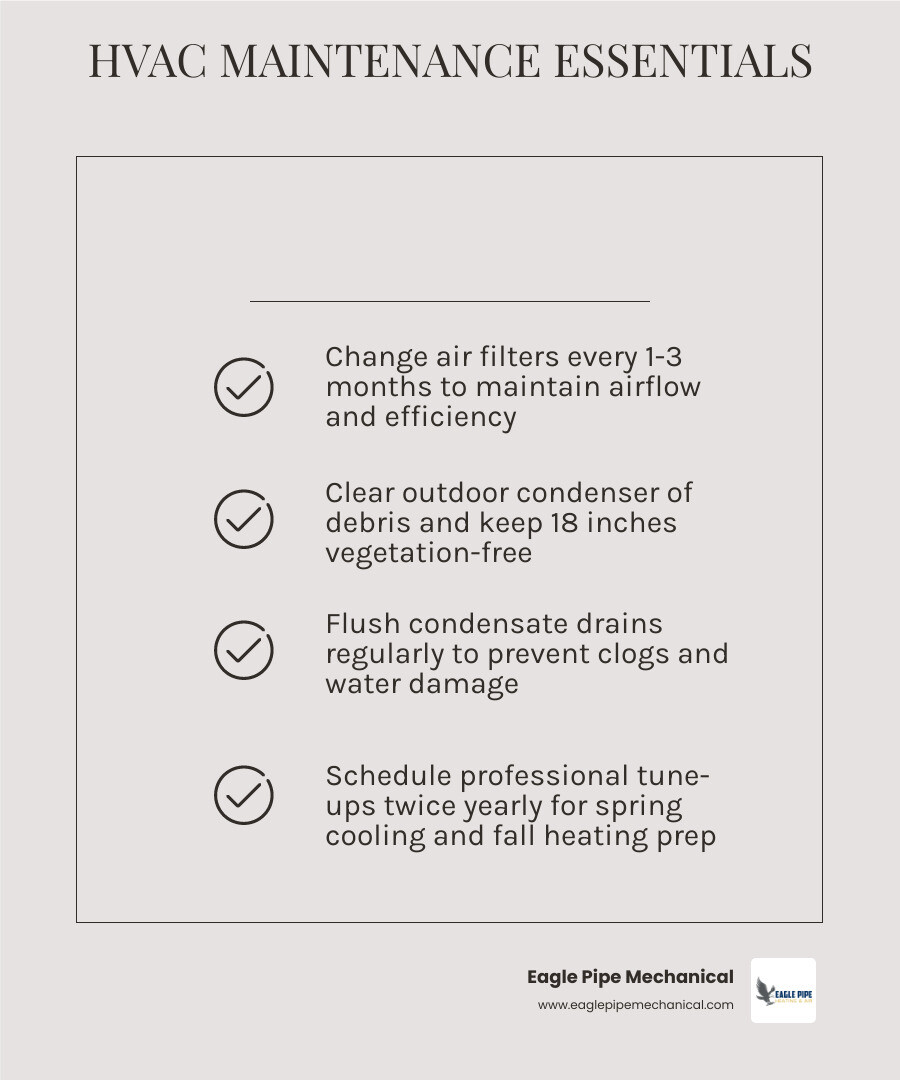
• Change Air Filters Regularly: Inspect filters monthly and replace them every 1 to 3 months, or more often if you have pets or dusty conditions.
• Clean Outdoor Unit: Keep the outdoor condenser unit clear of leaves, dirt, and debris. Ensure foliage is trimmed at least 18 inches away.
• Clear Condensate Drains: Periodically flush condensate drains to prevent clogs, which can lead to water damage and system shutdowns.
• Schedule Professional Tune-Ups: Arrange for professional maintenance twice a year: in spring for your cooling system and in fall for your heating system.
• Inspect Ductwork: Check accessible ductwork for leaks, holes, and loose connections. Seal any gaps with mastic sealant or metal tape.
• Check Thermostat Settings: Verify that your thermostat is set correctly for the season and consider using a programmable or smart thermostat for optimal efficiency.
Is your home in Kitsap or Jefferson County, WA, struggling to stay comfortable? Facing unexpected breakdowns or high energy bills from your heating and cooling system? Understanding how to maintain your heating and cooling system is key to avoiding these headaches, ensuring your home remains a haven of comfort year-round. Regular HVAC Maintenance not only extends the life of your equipment but also drastically improves energy efficiency and indoor air quality. For homeowners who value peace of mind and reliable performance, a proactive approach to your HVAC system is essential, especially with the unique weather patterns here in Kitsap and Jefferson County, WA.
Discover more about comprehensive home comfort solutions at Eagle Pipe Mechanical Home or schedule your service today at Schedule Service.
Ready to ensure your home’s comfort and efficiency? Contact Eagle Pipe Mechanical Today.
When we talk about home maintenance, the HVAC system is often “out of sight, out of mind”—at least until the furnace stops working on a damp Port Townsend morning or the AC fails during a rare July heatwave in Silverdale. However, your heating, ventilation, and air conditioning (HVAC) system is the heart of your home’s comfort.
Regular maintenance is not just a suggestion; it’s a necessity for several reasons:
1. Energy Savings: A clean system doesn’t have to struggle. When components are lubricated and filters are clear, the system uses less electricity and fuel to achieve the desired temperature.
2. System Longevity: Most furnaces are designed to last about 15 years, while air conditioners typically last 10 to 12. Without maintenance, these lifespans can be cut short by several years.
3. Indoor Air Quality: Your HVAC system circulates the air you breathe. Maintenance ensures that dust, pollen, and mold don’t take up residence in your ductwork or coils.
4. Safety: Especially with gas furnaces and boilers, regular checks prevent dangerous carbon monoxide leaks and fire hazards.
Following a Maintenance Checklist | ENERGY STAR is a great starting point for any homeowner. By staying on top of HVAC Preventive Maintenance, you’re investing in the long-term health of your home and your wallet.
The Role of Air Filters in How to Maintain Your Heating and Cooling System
If there is one DIY task that reigns supreme, it is the air filter change. Think of the air filter as the lungs of your HVAC system. Its primary job is to protect the internal components from dust and debris, but it also plays a massive role in your health.
In the Pacific Northwest, we deal with everything from seasonal pollen to woodsmoke and pet dander. When a filter becomes clogged, it restricts airflow. This forces the blower motor to work twice as hard, which can lead to overheating and mechanical failure. Recognizing Clogged Air Filter Signs—such as dusty vents or a whistling sound from the return—is the first step in protecting your system.
You might also wonder Why Your HVAC Filter Gets Dirty Faster during certain times of the year. If you’re doing home renovations in Poulsbo or have multiple furry friends in Kingston, you’ll need to check that filter more than once a month. The Importance of Regular Air Filter Replacement cannot be overstated; it is the simplest way to prevent the top cause of system breakdowns.
Impact on Monthly Utility Bills in 2026
As we move through 2026, energy costs remain a significant portion of the average household budget. In fact, nearly half of the average home’s $1,900 annual energy bill is dedicated solely to heating and cooling. If your system is neglected, you are essentially throwing money out the window.
Airflow problems caused by dirty coils or clogged filters can reduce your system’s efficiency by up to 15 percent. To put that into perspective, let’s look at how a maintained system compares to a neglected one:
• Efficiency Rating — Maintained System (Annual Tune-Up): Operates at peak manufacturer specs — Neglected System (No Maintenance): Up to 15% efficiency loss
• Monthly Bill — Maintained System (Annual Tune-Up): Stable and predictable — Neglected System (No Maintenance): Gradually increasing
• Repair Frequency — Maintained System (Annual Tune-Up): Rare, minor adjustments — Neglected System (No Maintenance): Frequent, emergency-level failures
• Airflow — Maintained System (Annual Tune-Up): Strong and consistent — Neglected System (No Maintenance): Weak, leading to hot/cold spots
• Lifespan — Maintained System (Annual Tune-Up): 15-20 years (Furnace) — Neglected System (No Maintenance): 10-12 years (Furnace)
Monitoring your energy bills for sudden spikes compared to the same month in previous years is a great way to “listen” to what your HVAC system is telling you.
How to Maintain Your Heating and Cooling System: A Homeowner’s Guide
While we always recommend professional help for the technical stuff, there are several things you can do yourself to keep things running. Learning how to maintain your heating and cooling system starts with a walk around your property.
In areas like Hansville or Seabeck, where vegetation grows quickly, the outdoor unit (the condenser) often gets “hugged” by shrubs or buried in falling leaves. Your outdoor unit needs to “breathe” to release the heat it pulls from inside your home.
• The 18-Inch Rule: Maintain at least 18 to 24 inches of clear space around your outdoor unit. Trim back weeds, bushes, and overhanging branches.
• Clear Debris: After a windstorm, check the top of the unit for twigs or needles that could interfere with the fan.
• Level Ground: Ensure the concrete pad under the unit hasn’t shifted or tilted, which can put strain on refrigerant lines.
For those using modern tech, Essential Heat Pump Maintenance Tips often include checking for ice buildup during our cold, wet winters. You can find more detailed guidance on Air Conditioner Maintenance | Department of Energy.
Cleaning and Clearing the Outdoor Condenser Unit
The metal “fins” on your outdoor unit act like a radiator. If they are covered in dirt, grime, or grass clippings, they can’t shed heat efficiently. You can gently hose down the outside of the unit with a garden hose (never use a pressure washer, as it will flatten the delicate fins!).
If you notice the fins are bent, a professional can use a specialized “fin comb” to straighten them out. This small fix can significantly improve airflow. For more DIY advice, check out our Essential Guide to AC Maintenance or these Heat Pump Maintenance Tips.
Monitoring Performance and Warning Signs
Your system will usually give you a “heads up” before it quits entirely. You just have to know what to look and listen for.
• Strange Noises: Squealing could mean a belt is slipping; banging might indicate a loose part; and clicking often points to an electrical issue.
• Odors: A “musty” smell often means mold in the ducts or a clogged drain line. A “burning” smell should be addressed immediately.
• Inconsistent Comfort: If the bedroom is freezing but the living room is sweltering, you might be dealing with Uneven Heating Issues Ductless Mini-Split systems or duct leaks.
• Short Cycling: If the system turns on and off every few minutes, it’s struggling to complete a cycle.
Often, these issues trace back to the filter. There are many Timely Air Filter Replacement Reasons, but preventing a total system shutdown is the most important one.
Seasonal Checklists for Kitsap and Jefferson County
Our climate in the Pacific Northwest is unique. We have high humidity, salty air near the coast in places like Port Ludlow and Suquamish, and temperatures that can swing wildly in the spring and fall. A seasonal approach to how to maintain your heating and cooling system is the best strategy.
Spring Checklist (Cooling Prep):
1. Remove any winter covers from the AC unit (but never cover a heat pump!).
2. Clean the outdoor coils.
3. Check the “condensate line” to make sure it isn’t clogged with algae.
4. Prepare Your AC for Spring by running a test cycle before the first hot day.
5. Perform Spring HVAC System Safety Checks on all electrical connections.
Fall Checklist (Heating Prep):
1. Test the furnace or boiler before the first frost.
2. Listen for unusual ignition noises.
3. Check your carbon monoxide detectors (replace batteries!).
4. Clear any debris from external vents (like the PVC pipes for high-efficiency furnaces).
Professional Support: How to Maintain Your Heating and Cooling System Long-Term
While DIY tasks are great, they don’t replace the trained eye of a technician. A professional tune-up involves checking things a homeowner simply can’t, such as refrigerant levels, gas pressure, and heat exchanger integrity.
At Eagle Pipe Mechanical, we offer the Eagle’s Nest Maintenance Plan. This isn’t just a quick “look-over.” It includes a comprehensive 37-point inspection designed to catch tiny problems before they become expensive disasters. Members also enjoy priority status and discounts on repairs. Think of it as a HVAC Service Contract that pays for itself in peace of mind. You can learn more about the specifics on our Maintenance Plan page.
Heating System Specifics: Furnaces and Boilers
For those in older homes in Bremerton or Port Townsend, you might have a boiler or an older gas furnace. These require specific safety checks.
• The Heat Exchanger: This is the part that keeps combustion gases separate from the air you breathe. If it cracks, carbon monoxide can enter your home. A professional inspection is the only way to verify it’s safe.
• Gas Connections: We check for leaks and ensure the burner is firing with a crisp blue flame, not a flickering yellow one.
• Boiler Pressure: We ensure the water levels and pressure are correct to prevent “no heat” situations.
Whether you need a Furnace Tune-Up Poulsbo WA Guide or a Furnace Tune-Up Silverdale WA, getting an expert to look at your heating system before winter is a smart move.
Maximizing Efficiency with Duct Sealing and Smart Tech
Did you know that in a typical house, about 20 to 30 percent of the air that moves through the duct system is lost due to leaks, holes, and poorly connected ducts? That is like paying for five gallons of milk but only getting four home because the carton is leaking.
Sealing ducts in “unconditioned” spaces like attics or crawlspaces can make a huge difference in your comfort. We use mastic sealant or metal tape—never actual “duct tape,” which ironically dries out and fails quickly on ducts. Proper sealing combined with Whole House Air Filtration Poulsbo WA ensures that the air you pay to heat or cool actually reaches your rooms. You can read more about Indoor Air Quality Poulsbo WA and How to Keep Your HVAC System Working Efficiently | ENERGY STAR to see how these factors work together.
Thermostat Calibration and Smart Integration
Your thermostat is the “brain” of the operation. If it’s poorly located (like in direct sunlight or near a drafty door in Indianola), it will give the system wrong instructions.
Modern smart thermostats are a game-changer for how to maintain your heating and cooling system. They can:
• Send you alerts when it’s time to change the filter.
• Provide monthly energy reports to show where you’re spending the most.
• Allow you to adjust the temp from your phone while you’re at a ferry terminal.
Integrating smart tech is a key part of Air Quality Improvement. If you’re concerned about what’s in your air, we also offer Air Quality Testing Hansville to help you choose the right filtration level.
Ventilation and Humidity Control
In the Pacific Northwest, moisture is our constant companion. Your HVAC system helps manage this through the “condensate drain.” As the AC or heat pump cools the air, it also removes moisture. This water has to go somewhere.
If the drain line clogs, the water can back up into your home, causing mold or damaging your furnace’s circuit board. Periodically checking that the drain is flowing freely is a vital step. This is especially important for residents needing Air Filter Replacement Port Townsend WA or Air Filter Replacement Bainbridge Island WA, as high humidity can make filters get “gunked up” faster.
Frequently Asked Questions about HVAC Care
How often should I change my air filters?
For most homes, we recommend a monthly inspection. If the filter looks gray or has a visible layer of dust, change it. Generally, this happens every 1 to 3 months. If you have pets, allergies, or live in a high-dust area like a new construction zone in Gig Harbor, you’ll be on the shorter end of that window. Crucial Regular Air Filter Replacement is the best way to keep your air clean.
What is the typical lifespan of a heating and cooling system?
A well-maintained gas furnace can last 15 to 20 years. Central air conditioners and heat pumps usually last 10 to 15 years. Boilers often have the longest life, sometimes reaching 20+ years if the water chemistry is maintained. Regular Heat Pump Maintenance is the key to hitting those high numbers.
When should I consider replacing my old equipment?
If your system is over 12 years old and requires a repair that costs more than half of its value, it’s usually time to upgrade. Other signs include rapidly rising energy bills and a system that can no longer keep up with the weather. If you’re in Port Orchard or need Air Filter Replacement Bremerton WA, we can help evaluate if a repair or a more efficient replacement is the better investment.
Conclusion
Maintaining your home’s HVAC system doesn’t have to be a chore. By handling the simple DIY tasks and partnering with a trusted professional for the technical tune-ups, you can ensure your home stays a “comfort zone” regardless of what the Washington weather throws at us.
Eagle Pipe Mechanical is proud to be a 100% women-owned and operated business serving Kitsap and Jefferson Counties. With over 45 years of experience, we bring a personable, honest, and highly efficient approach to every home we visit. From Poulsbo to Port Townsend, and Bainbridge Island to Belfair, our mission is to provide you with expert solutions that reduce energy consumption and maximize your comfort.
Ready to give your HVAC system the care it deserves? Join our Eagle’s Nest maintenance plan today and experience the difference that professional, dedicated service makes.
Explore Expert HVAC Maintenance and Solutions or call us to schedule your next tune-up!
CUSTOMER TESTIMONIALS
Our customers’ experiences say more than we ever could. See how Eagle Pipe Heating & Air has earned trust across the Pacific Northwest with reliable service and lasting results.